
Exhibitions
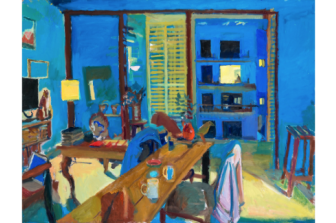
Natalia Zourabova Living in Painting
Be it in Moscow, Berlin, Be'er Sheva, or Jaffa, Natalia Zourabova primarily paints the interior of her home. The gaze at the living environment is a means of adapting to it, and Zourabova discovers the place through painting; more accurately: by rendering the domestic interior, she discovers painting. Interior depictions tie the home to the studio, life to work. The painting is created in a familiar, loved place, but at the same time it pits the challenges of life against those of painting. Every moment spent at home is a time of studying the act of painting while mapping the space, perusing the shapes, colors, and textures that make up her habitat.
Saturday, 29.06.24
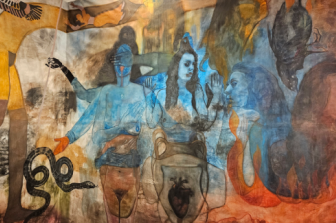
Merav Sudaey: Of Goddess Born
Merav Sudaey's exhibition space was transformed into a cave with painted walls, a ritual site for an ancient goddess. She draws inspiration from wall paintings in Hindu and Buddhist temples and monasteries, replacing all the figures with the image of one woman, her own. This painterly installation thus consists of a stratified series of self-portraits in which Sudaey examines her naked body as an object for painting while looking into herself as a subject. Applying diluted paint to the canvas, she heaps transparent layers one atop the other, which conceal or reveal spectral underlayers of female nudity. The two-dimensional canvas is rendered three-dimensional, as it were, as additional painterly worlds are waiting to be discovered under the top layer of paint.
Saturday, 22.02.25
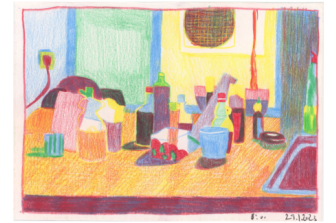
My own room | The BFAMI Family Gallery
My room is my best place. We decide what to hang on the walls in it, we keep the most important things in it, and we close ourselves in it when we want to be only with ourselves.
We invite you to show us what your room looks like, or the room of your dreams: draw the room on a postcard, and be sure to describe the objects and details that make it your special place, different from all other rooms.
Saturday, 29.06.24
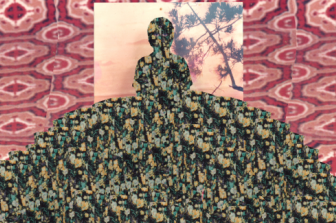
Space for Community Art: Rachel Anyo Figure Coming to Life
Rachel Anyo creates a new visual image of a feminist Ethiopian woman. She recruited 13 differently-aged women of Ethiopian origin for the project, and together they explored their culture by working in the collage technique. Based on a database of images prepared by Anyo from her family albums, the participants created collages under the guidance of the artist, who deconstructed and reconstructed them into new collages all her own.
Saturday, 22.02.25
Space for Community Art: Liron Hana Ohayon & Amit Gavish 6+1
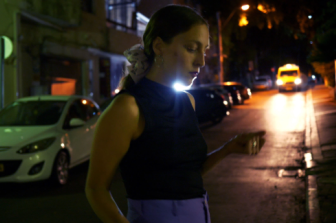
Equipped with white overalls, compassion and courage, Liron Hana Ohayon and Amit Gavish lead an interdisciplinary artistic act in the streets of Haifa. They gathered six women who recently moved to Haifa for a joint creative process, which included a confession and a statement of identity aimed at pushing the boundaries of involvement in the space. The six video works on view are elaborations of six acts of female healing, whose gist is coping together with personal passions and fears.
Saturday, 22.02.25
Northern Wind | Israeli Art from the Museum's Collection
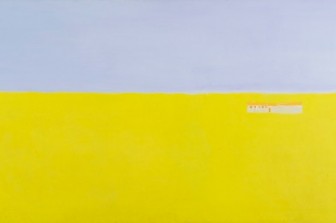
A north wind blows through the collection of Haifa Museum of Art. The museum’s location in the city of Haifa is reflected in its collection, which contains many works by artists based in Haifa and the north, attesting to Haifa’s unique identity: as a port city, the relation to immigrants and refugees repeatedly surfaces in the works; as a workers’ city, many of the works address class issues; and as a city nestled in a unique topography between the sea and the mountain, the works delve into interrelations between the earthly and the spiritual. From its focal point in the north, the collection also converses with Israel’s art centers, with Arab culture, and with Western modern art: turning south, to artistic practice in Tel Aviv and Jerusalem; east, beyond the Jordan Valley; and west, to what is happening overseas.
Saturday, 22.02.25
Duos
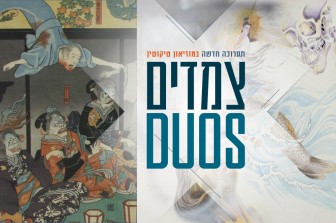
The "Duos" exhibition connects between traditional Japanese woodblock print artists and contemporary Japanese and Israeli artists. The first duo, Hiroshige X Tabaimo, is a connection between one of the greatest 19th century print artists, Utagawa Hiroshige, and the contemporary video artist Tabaimo. The second duo, Kuniyoshi X Kuperman, is a connection between the woodblock print artist Utagawa Kuniyoshi and the Israeli painter Ruven Kuperman. The connecting point of another duo, Hokusai X Balaban, is the aesthetics of images of warriors with a special emphasis on movement, and these are depicted in the warrior books of the artist Katsushika Hokusai and translated to the unique and refined language of the artist Yael Balaban.
Saturday, 25.05.24
A New World of Paper - Gallery for Families
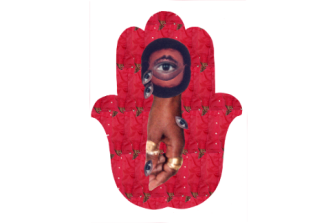
Collage is an important technique in art. It allows you to connect different worlds and create things that only exist in the imagination. To create a collage, you cut images from different sources, take them apart, and then put the pieces together in a new, surprising way. The odder the cuts and links, the more striking the resulting new creation.
Saturday, 22.02.25
Reproductions and Expressions
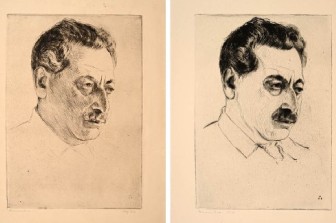
The collection was started by Tzvi Neta’s father, Mr. Yosef (Joe) Boxenbaum, one of Israel’s first industrialists and a passionate Zionist, who purchased the works about two decades after Struck’s death, apparently from the artist’s widow. Much can be learned about Struck’s creative processes from this collection. Many of the prints were copies but not duplicates. Comparing them reveals much about the depth of thought involved in Struck’s work process. For this reason, I asked to curate an exhibit based on Mr. Neta’s donation.
Saturday, 04.05.24
Please contact us and we will contact you as soon as possible